Henry Hill remains one of the most recognizable names associated with the American Mafia, largely because his life became the foundation for Martin Scorsese’s celebrated 1990 film Goodfellas. Born in Brooklyn in 1943, Hill entered the world of organized crime while still young and eventually became an associate of the Lucchese crime family. His unusual journey later took him from the streets of New York to federal witness protection, making his story one of crime, betrayal, survival, and reinvention.
| Quick Bio | Details |
|---|---|
| Full Name | Henry Hill Jr. |
| Born | June 11, 1943 |
| Birthplace | Brooklyn, New York, U.S. |
| Known For | Mafia associate and federal informant |
| Criminal Association | Lucchese crime family |
| Wife | Karen Friedman |
| Children | Gregg and Gina |
| Famous Film | Goodfellas |
| Portrayed By | Ray Liotta |
| Died | June 12, 2012 |
| Age at Death | 69 |
| Place of Death | Los Angeles, California |
Who Was Henry Hill?
Henry Hill was not a traditional made member of the Mafia, despite spending decades around organized crime figures. His Irish father and Sicilian mother meant he did not meet the Mafia’s traditional requirements for becoming a fully initiated member. Instead, he operated as an associate and earned trust through criminal work, relationships, and his willingness to participate in increasingly serious activities.
Growing up in Brooklyn, Hill became fascinated with neighborhood gangsters at an early age. By his teenage years, he was already running errands and performing small jobs for people connected to Paul Vario, a powerful Lucchese crime family figure. What began as youthful admiration gradually became a criminal career that lasted for roughly 25 years.
Henry Hill and the Lucchese Crime Family
Hill’s connection with the Lucchese organization introduced him to a criminal world built around gambling, theft, hijacking, extortion, and other illegal enterprises. He developed relationships with figures such as Paul Vario and James “Jimmy the Gent” Burke, both of whom later became important parts of his story and the Goodfellas narrative.
His position gave him access to a lifestyle that appeared glamorous from the outside but carried significant risks. Money, nightlife, expensive entertainment, and social status existed alongside violence, intimidation, addiction, and constant fear. Hill later described the darker consequences of that lifestyle, acknowledging that his criminal activities had caused serious harm.
The Lufthansa Heist and Henry Hill
One of the most famous crimes connected to Hill was the 1978 Lufthansa heist at John F. Kennedy International Airport. The robbery involved millions of dollars in cash and became one of the most notorious American organized-crime robberies of its era. Hill was associated with the operation, while Jimmy Burke was widely identified as one of its central figures.
The robbery also became important because of what happened afterward. Investigators pursued those connected to the crime, while members of the criminal group became increasingly concerned about witnesses and potential informants. The violence surrounding the robbery later became one of the most memorable elements associated with Hill’s real-life story and its cinematic adaptation.
Henry Hill Becomes a Federal Informant
Hill’s criminal career eventually began to collapse when authorities arrested him on narcotics-related charges in 1980. Facing severe legal consequences, he decided to cooperate with federal investigators. His decision transformed him from a criminal associate into a government witness whose information could be used against former colleagues.
His cooperation had major consequences for the people around him. Hill provided testimony that helped prosecutors secure numerous convictions, including cases involving Paul Vario and James Burke. Contemporary accounts describe his cooperation as contributing to roughly 50 convictions, making him an important government witness against the criminal network he had once served.
Henry Hill and Witness Protection
After becoming an informant, Hill entered the Federal Witness Protection Program with his wife Karen and their children. The family was relocated and lived under changed identities as authorities attempted to protect them from people who had reason to seek revenge against Hill. Their lives became radically different from the Brooklyn environment they had previously known.
However, Hill struggled with the restrictions associated with living under protection. He continued engaging in criminal activity and repeatedly attracted attention that undermined the purpose of the program. Eventually, he was removed from federal witness protection, ending the period in which the government formally protected him through the program.
Henry Hill Family and Personal Life
Henry Hill’s family experienced the consequences of his criminal lifestyle alongside him. He married Karen Friedman in 1965, and they had two children, Gregg and Gina. Their marriage eventually ended, with the divorce finalized years after the couple separated. The family’s experiences during Hill’s criminal career and time in hiding later became part of the broader story surrounding his life.
Hill’s relationship with his children was complicated by his criminal past and the instability that followed his decision to cooperate with authorities. His children later shared their perspective in On the Run: A Mafia Childhood, offering another view of what it meant to grow up while their father was involved with organized crime and subsequently entered witness protection.
Henry Hill and Goodfellas
The story of Henry Hill became internationally famous through Nicholas Pileggi’s book Wiseguy: Life in a Mafia Family. Published in the mid-1980s, the book drew upon Hill’s experiences and provided the foundation for what would become one of the most influential gangster films in American cinema.
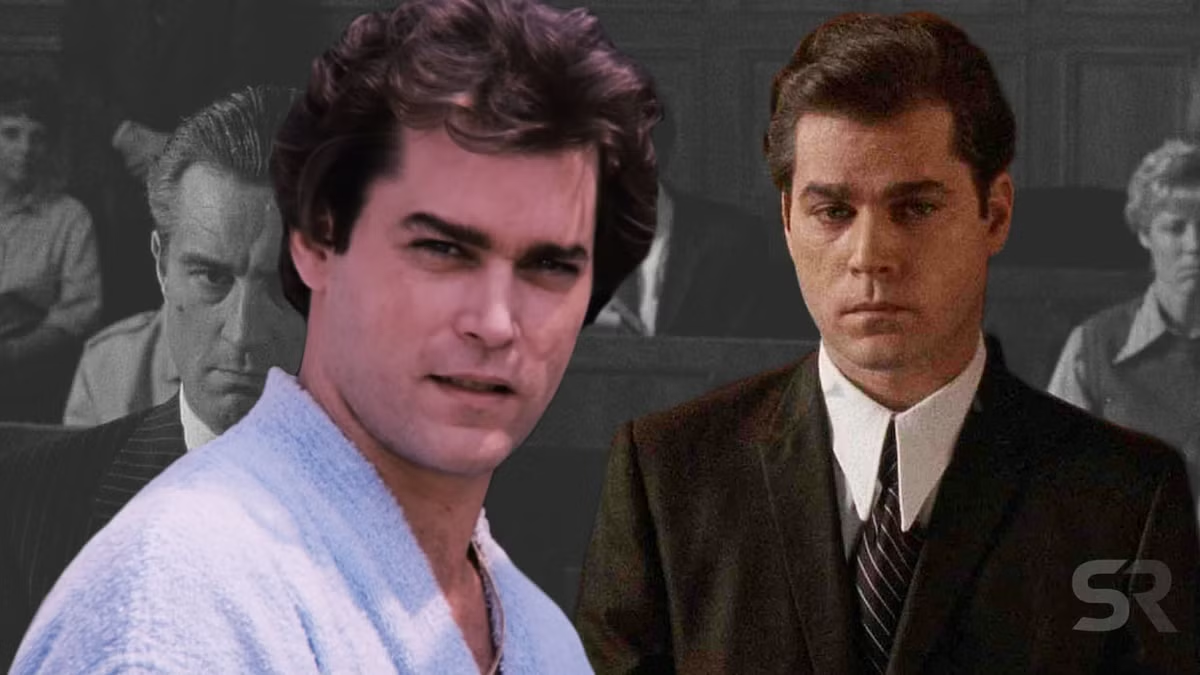
Martin Scorsese adapted Pileggi’s work into Goodfellas, released in 1990. Ray Liotta portrayed the fictionalized version of Hill, while Robert De Niro, Joe Pesci, and other performers portrayed characters based partly on people from Hill’s criminal world. The film received six Academy Award nominations and helped turn Hill’s name into a lasting part of popular culture.
How Accurate Was Goodfellas?
People interested in Henry Hill often wonder how closely Goodfellas followed his actual life. The film dramatized events and characters for storytelling purposes, but its central framework came from Hill’s experiences and Pileggi’s reporting. Hill himself reportedly considered the movie highly accurate in many respects, although some details were inevitably changed or compressed for cinema.
The movie particularly captured the contrast between the excitement of organized crime and its consequences. Hill’s rise, his relationships with criminals, his involvement in major schemes, his drug problems, and his eventual cooperation with authorities all formed important parts of the real story. Yet the real Hill’s life continued for more than two decades after the period depicted in the film.
Henry Hill After Goodfellas
The release of Goodfellas made Hill a public figure, despite the fact that his real life had previously depended on secrecy. He appeared in interviews and television programs and spoke publicly about his experiences in organized crime. His notoriety became a source of income as he participated in media appearances and commercial activities connected to his unusual past.
Hill also attempted to move in a different direction later in life. According to biographical accounts, he studied to become a drug and alcohol counselor and tried to establish a life that was less connected to the criminal identity that had followed him for decades. Nevertheless, his association with the Mafia and Goodfellas remained central to how the public viewed him.
Henry Hill’s Later Years
During his later years, Hill lived in California and remained a familiar figure in true-crime and entertainment discussions. He continued speaking about his past, sometimes appearing on radio and television programs. His public persona was unusual because he was simultaneously remembered as a former criminal, a government informant, and the real-life inspiration for a famous movie character.
His later life also reflected the long-term consequences of his earlier choices. Addiction, criminal associations, damaged relationships, and the psychological burden of betrayal were recurring themes in accounts of his life. Rather than ending with the dramatic final scene of Goodfellas, Hill’s real story continued through years of public attention and personal struggles.
How Did Henry Hill Die?
Henry Hill died on June 12, 2012, in Los Angeles, just one day after his 69th birthday. Reports described longstanding health problems and complications involving his heart. His death was not the violent ending many people might have expected from someone whose life had been surrounded by organized crime.
His death brought renewed attention to the extraordinary path he had taken. Hill had survived decades around violent criminals, cooperated with federal authorities, lived under witness protection, and eventually became famous because his experiences inspired one of the most celebrated crime films ever made. His final years were far removed from the Brooklyn streets where his criminal career had begun.
Henry Hill’s Legacy
The lasting fascination with Henry Hill comes from the contradictions within his story. He was simultaneously an ambitious young man attracted to organized crime, a participant in serious criminal activity, a drug trafficker, a government informant, and eventually a public personality. Each stage of his life presented a different version of the same complicated individual.
His greatest cultural legacy is undoubtedly Goodfellas. Through the film, millions of viewers encountered a dramatized version of Hill’s world and gained an impression of how organized crime could combine social glamour with fear, violence, betrayal, and destruction. The film’s continued popularity has ensured that Hill’s name remains connected to American crime history.
Final Thoughts on Henry Hill
Henry Hill’s life was far more complicated than the fictionalized version audiences encountered on screen. His journey from a Brooklyn teenager fascinated by gangsters to a Lucchese crime family associate, federal informant, witness-protection participant, and internationally recognized figure demonstrates how dramatically criminal choices can reshape a person’s life.
Today, Henry Hill is remembered primarily because his experiences inspired Goodfellas, but the real story extends beyond the movie. His life involved criminal ambition, family disruption, cooperation with law enforcement, addiction, fear, public notoriety, and attempts at personal change. That complicated history is precisely what continues to make Henry Hill a subject of fascination decades after his most notorious years ended.
Read more: Kathleen Nimmo Lynch: Biography, Career, Family, and Life Beyond the Headlines