If you recently received a complete blood count (CBC) and noticed that your RDW was higher than the reference range, it is natural to wonder what the number means. RDW, or red cell distribution width, measures how much your red blood cells differ in size and volume. A high result can provide an important clue about anemia or another underlying condition, but RDW by itself does not usually determine how serious a problem is.
| Quick Fact | Details |
|---|---|
| Full name | Red Cell Distribution Width |
| Common reference range | About 12%–15% |
| High RDW | Usually above the laboratory’s reference range |
| Main purpose | Measures variation in red blood cell size |
| Commonly interpreted with | MCV, hemoglobin, hematocrit and other CBC results |
| Can indicate | Anemia, nutritional deficiencies and other conditions |
What Level of RDW Is Dangerous?
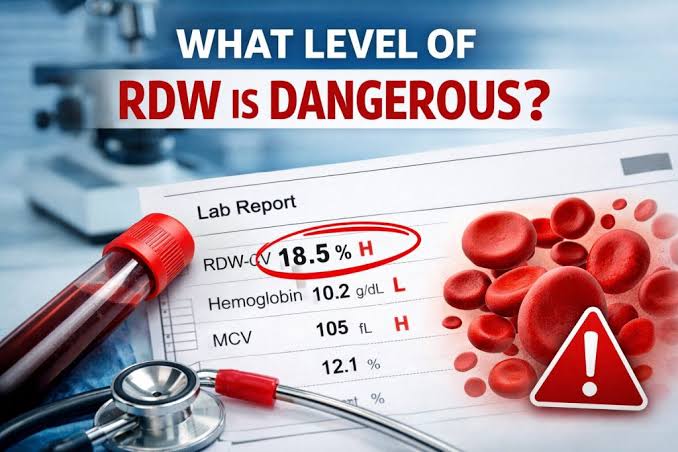
There is no single RDW number that is considered universally dangerous. Most laboratories consider an RDW around 12% to 15% to be within the usual range, although reference intervals can differ between laboratories. Therefore, an RDW of 16% or 17% may be flagged as high without necessarily representing an emergency.
The more important question is why the RDW is elevated and what your other blood results show. Doctors commonly interpret RDW together with MCV, hemoglobin, hematocrit, red blood cell count and other findings rather than using RDW as an isolated measure of disease severity.
A very high RDW can indicate that your red blood cells vary considerably in size, but the number itself does not automatically mean that you have a dangerous condition. Someone with a moderately elevated RDW and significant anemia may need more urgent evaluation than someone with a higher RDW but otherwise reassuring blood results.
Is an RDW Above 15% Dangerous?
An RDW above 15% is commonly considered elevated, but it should not automatically be described as dangerous. Cleveland Clinic notes that RDW results of 15% or higher may indicate greater variation in red blood cell size, while the normal range is commonly around 12% to 15%.
For example, an RDW of 16% may be only mildly outside a laboratory’s reference interval. An RDW of 18% or 20% represents greater variation, but even those values require context before their significance can be determined.
The presence of symptoms and abnormalities in other CBC measurements is often more important than the RDW number alone. A healthcare professional may investigate nutritional deficiencies, anemia, chronic disease or other possible explanations based on the complete pattern.
What Does a High RDW Mean?
A high RDW means that your red blood cells are more varied in size than expected. Normally, red blood cells are relatively similar in size, allowing them to perform their oxygen-carrying function efficiently. Greater variation is sometimes called anisocytosis.
High RDW is frequently associated with different types of anemia. Iron deficiency, vitamin B12 deficiency and folate deficiency can affect red blood cell production and produce populations of cells with different sizes.
However, nutritional deficiency is not the only possible explanation. High RDW can also occur alongside conditions involving the liver, kidneys, heart and other chronic illnesses. Your doctor may therefore need additional testing rather than assuming that an elevated RDW means you simply need more iron.
Why RDW and MCV Are Often Checked Together
RDW becomes more useful when it is considered alongside MCV, which measures the average size of red blood cells. MCV can help classify anemia according to whether the cells are generally small, normal-sized or large.
For example, a high RDW with a low MCV can occur with iron deficiency anemia. A high RDW with a high MCV may point toward conditions involving vitamin B12 or folate deficiency, although these patterns are not diagnostic by themselves.
A normal MCV does not necessarily mean everything is normal. Early nutritional deficiency or mixed causes of anemia can produce a combination of red blood cells with different sizes, which may raise RDW while the average cell size remains within the reference range.
What Causes a High RDW?
Iron deficiency is one important cause of an elevated RDW. When the body does not have enough iron to produce healthy red blood cells, newly produced cells can differ in size from older cells, increasing the variation measured by the test.
Vitamin B12 and folate deficiencies can also affect red blood cell production. These deficiencies may lead to larger-than-normal red blood cells and changes in other CBC measurements. Further blood testing may be necessary to determine whether a nutritional deficiency is actually present.
Chronic illnesses can also be associated with abnormal RDW results. MedlinePlus lists conditions such as chronic liver disease, heart disease, diabetes, kidney disease and some cancers among conditions that may be associated with high RDW.
Blood loss is another possible reason for investigating an abnormal result. When the body responds to blood loss by producing new red blood cells, differences between newer and older cells may affect RDW.
Can High RDW Mean Anemia?
Yes, a high RDW can be associated with anemia, but RDW does not diagnose anemia by itself. Anemia involves inadequate red blood cells or hemoglobin for the body’s needs, and the diagnosis depends on measurements such as hemoglobin and hematocrit along with the clinical situation.
People with anemia may experience fatigue, weakness, dizziness, headaches, pale skin, shortness of breath or changes in heart rhythm. These symptoms can vary considerably depending on the cause and severity of the anemia.
If your RDW is elevated and your hemoglobin is also low, your healthcare provider may investigate the reason for the anemia. Depending on the circumstances, testing may include iron studies, vitamin levels, a blood smear and additional laboratory investigations.
What RDW Level Should Make You Concerned?
Instead of focusing on one specific RDW cutoff, look at the entire CBC report. A mildly elevated RDW without anemia or concerning symptoms may be less urgent than an abnormal RDW accompanied by substantially abnormal hemoglobin or other blood-count results.
Your laboratory’s own reference range should also be considered. Different laboratories can use different testing systems and reference intervals, so comparing your result with a generic internet range can sometimes create unnecessary concern.
A persistent abnormal result deserves discussion with a healthcare professional, particularly if you have symptoms or other abnormal CBC measurements. The goal is to identify the underlying cause rather than simply trying to lower the RDW number.
When Is High RDW an Emergency?
High RDW alone generally does not establish that someone is experiencing a medical emergency. However, symptoms associated with significant anemia or another serious condition can require urgent assessment.
Seek urgent medical attention if you develop severe shortness of breath, chest pain, fainting, severe weakness or significant heart-rhythm symptoms. Palpitations accompanied by chest pain, shortness of breath or fainting warrant immediate medical attention.
If you feel severely unwell, do not wait for an RDW result to determine whether you need care. The severity of symptoms and the overall clinical picture matter more than an isolated laboratory measurement.
What Tests Are Used After a High RDW?
Your healthcare provider may first review the rest of your CBC. Hemoglobin, hematocrit, MCV, MCH, MCHC and red blood cell count can provide important information about the type and possible cause of an abnormal red blood cell pattern.
If iron deficiency is suspected, additional testing may evaluate iron status. If vitamin deficiency is suspected, vitamin B12 and folate levels may be considered. The exact tests depend on your symptoms, medical history and other laboratory findings.
A peripheral blood smear may also be useful in selected cases because it allows healthcare professionals to examine the appearance and size of red blood cells directly. This can provide information that a numerical RDW value cannot provide on its own.
Can You Lower a High RDW?
There is no universal treatment designed simply to lower RDW. The appropriate approach is to identify and treat the condition responsible for the abnormal red blood cell pattern.
For example, if testing confirms iron deficiency, treatment may involve iron replacement and investigation of why the deficiency developed. If vitamin B12 or folate deficiency is responsible, the treatment will be different.
It is important not to start iron or other supplements solely because your RDW is high. MedlinePlus advises discussing supplements and dietary changes with a healthcare provider because treatment should be based on the actual cause of the abnormal results.
What Level of RDW Is Dangerous During Pregnancy?
Pregnancy can change several blood measurements, so an RDW result during pregnancy should be interpreted using the appropriate clinical context and laboratory reference ranges. A high RDW does not automatically mean that there is danger to the mother or baby.
Iron deficiency and anemia are important considerations during pregnancy, which is why healthcare professionals may monitor hemoglobin and other blood indices. If an abnormal RDW appears alongside anemia or symptoms, your healthcare provider can determine whether additional testing or treatment is needed.
Pregnant patients should discuss abnormal blood results with their prenatal care provider rather than interpreting an RDW value alone. The correct assessment depends on the complete blood count, symptoms, pregnancy stage and individual medical history.
What Should You Do If Your RDW Is High?
Start by checking the reference range printed on your laboratory report. Then look at your hemoglobin, MCV and other CBC values instead of judging the RDW in isolation.
If the result is only slightly elevated and you feel well, it may not represent an immediate danger, but it is still worth discussing with your healthcare provider. A persistent abnormality may deserve further investigation.
If you have fatigue, dizziness, weakness, shortness of breath, pale skin or palpitations, mention these symptoms when discussing your blood test. They can help your healthcare professional determine whether anemia or another condition needs attention.
Final Answer: What Level of RDW Is Dangerous?
So, what level of RDW is dangerous? There is no universally accepted RDW percentage at which the result itself becomes dangerous. A result above roughly 15% is commonly considered elevated, but the clinical importance depends on your laboratory’s range and the rest of your blood results.
A high RDW is best viewed as a clue rather than a diagnosis. It may point toward anemia, nutritional deficiency, chronic disease or another issue that requires further evaluation.
If your RDW is high, ask your healthcare provider to interpret it alongside your hemoglobin, MCV and other CBC measurements. If you have severe symptoms such as chest pain, fainting or significant difficulty breathing, seek urgent medical care rather than relying on the RDW number alone.
Read more: When Is UStudioBytes Going to Be Live? Latest Launch Information and What Users Should Know