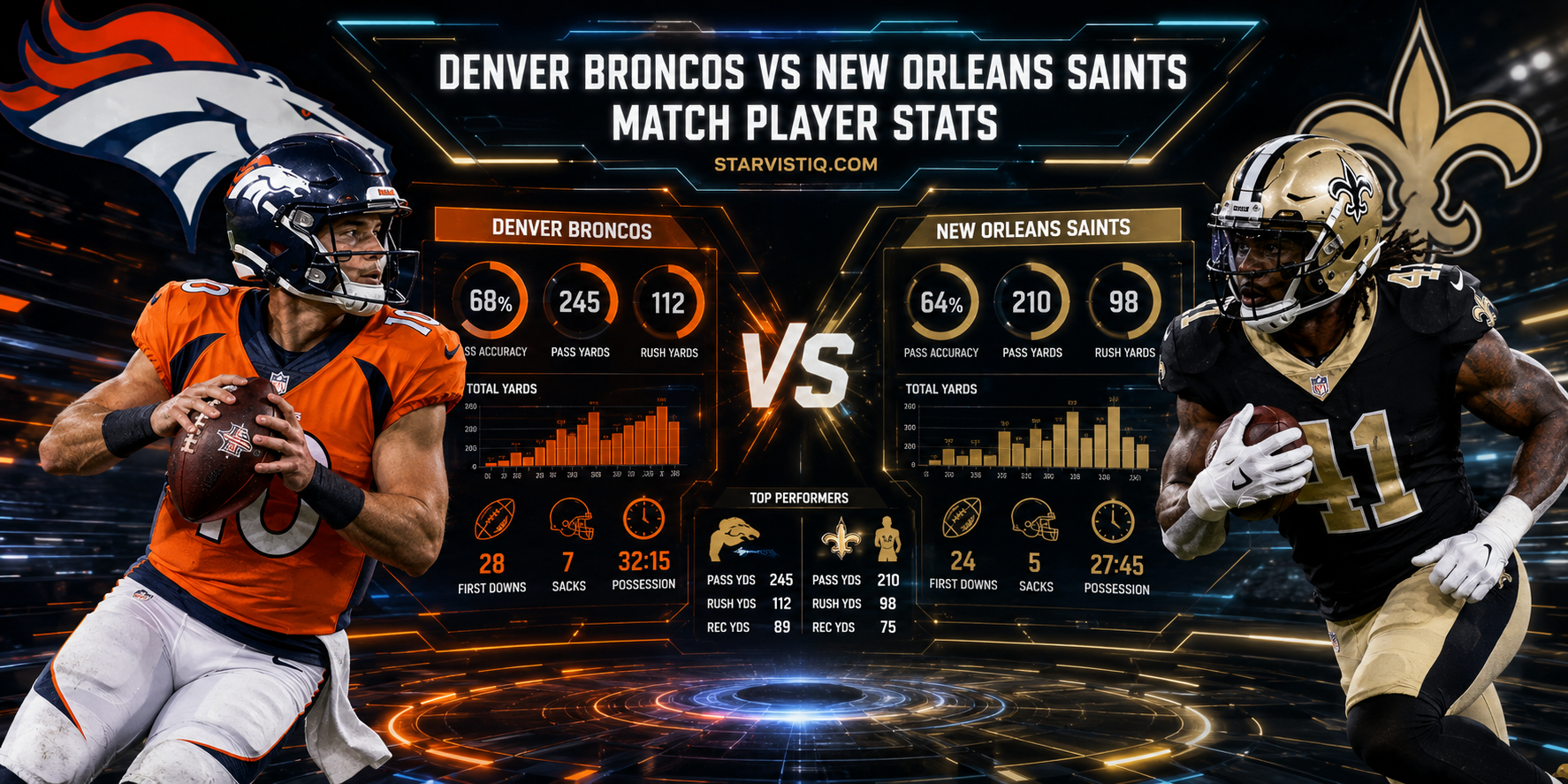
The Denver Broncos defeated the New Orleans Saints 28-19 in their 2025 preseason meeting at Caesars Superdome on August 23, 2025. The game featured several notable individual performances, including strong passing from Bo Nix and Sam Ehlinger, an impressive receiving display from Courtland Sutton, and useful contributions from younger players.
Quick Match Facts
| Category | Denver Broncos | New Orleans Saints |
|---|---|---|
| Final Score | 28 | 19 |
| Venue | Caesars Superdome | Caesars Superdome |
| Passing Yards | 308 gross | 182 gross |
| Net Passing Yards | 293 | 160 |
| Rushing Yards | 103 | 76 |
| Total Yards | 396 | 236 |
| First Downs | 22 | 16 |
| Time of Possession | 36:51 | 23:09 |
| Touchdowns | 3 | 1 |
| Field Goals | 3 | 4 |
The Broncos controlled much of the statistical battle despite New Orleans producing more points than Denver during the opening quarter. Denver finished with 396 total yards compared with 236 for the Saints, while also holding a significant advantage in time of possession. Those numbers help explain how Denver eventually turned a competitive opening into a comfortable nine-point victory.
Denver Broncos vs New Orleans Saints Match Player Stats
The most interesting part of the Denver Broncos vs New Orleans Saints match player stats was the quarterback rotation. Denver used Bo Nix and Sam Ehlinger, while New Orleans gave opportunities to Tyler Shough, Spencer Rattler, and Jake Haener. The different workloads made the game particularly useful for evaluating depth and competition across both rosters.
Bo Nix completed 10 of 14 passes for 110 yards and one touchdown without throwing an interception. His most important completion came on a 19-yard touchdown pass to Courtland Sutton in the second quarter. Nix was particularly effective during Denver’s scoring drive, helping the Broncos establish their first offensive touchdown of the afternoon.
Sam Ehlinger handled a much larger passing workload after Nix’s appearance. He completed 22 of 31 attempts for 198 yards, one touchdown, and one interception. His late connection with Kyrese Rowan produced a five-yard touchdown that helped Denver close the game after the Saints had reduced the deficit to three points.
Denver Broncos Passing Statistics
Nix’s 110 passing yards and Ehlinger’s 198 yards combined for 308 gross passing yards. Denver completed 32 of 45 attempts and finished with 293 net passing yards after accounting for sacks. The Broncos also recorded two passing touchdowns, giving their quarterbacks a productive overall afternoon.
Ehlinger’s performance was especially important because he had considerably more opportunities to operate the offense. Although the interception prevented a completely clean outing, his 22 completions and 198 yards showed that he could move the offense consistently and produce when Denver needed points late in the game.
Courtland Sutton Leads the Receiving Attack
Courtland Sutton was the standout receiver in the Denver Broncos vs New Orleans Saints match player stats. He finished with four receptions for 83 yards and one touchdown, averaging more than 20 yards per reception. His longest reception traveled 43 yards and helped demonstrate his ability to create explosive plays downfield.
Sutton’s touchdown came on a 19-yard pass from Nix during the second quarter. The play gave Denver its first touchdown of the contest after the Broncos had initially relied on field goals. His production also highlighted the importance of the connection between Denver’s starting quarterback and one of its primary receiving targets.
Luke Krull also made a noticeable contribution, recording three receptions for 49 yards. Kyrese Rowan added four catches for 33 yards and scored the decisive five-yard touchdown from Ehlinger in the fourth quarter. Tyler Badie contributed four receptions for 31 yards while also carrying the ball four times.
Audric Estime Provides a Strong Running Performance
Audric Estime produced Denver’s best rushing performance, carrying the ball eight times for 45 yards and scoring a five-yard touchdown. His 5.6 yards per carry represented efficient production and gave the Broncos a useful contribution from the running game during the second half.
Sam Ehlinger also contributed 25 rushing yards on six attempts, with a long run of 19 yards. Tyler Badie added 14 yards on four carries, while Blake Watson recorded 13 yards. Denver ultimately finished with 103 rushing yards on 27 attempts, averaging 3.8 yards per rushing play.
The running statistics were not spectacular compared with Denver’s passing production, but they were sufficient to keep the offense balanced. Estime’s touchdown was particularly valuable because it came during the third quarter, when Denver began creating separation after leading only 16-9 at halftime.
New Orleans Saints Quarterback Statistics
Tyler Shough led the Saints in passing, completing 12 of 20 attempts for 102 yards. He did not throw a touchdown or interception, but he added 20 rushing yards and scored an 11-yard rushing touchdown in the fourth quarter. His dual-threat contribution gave New Orleans an important spark late in the game.
Spencer Rattler completed five of eight passes for 43 yards, while Jake Haener completed five of nine for 37 yards. Together, the Saints quarterbacks completed 22 of 37 passes for 182 gross yards, with no passing touchdowns and no interceptions. The lack of a passing touchdown limited New Orleans’ ability to match Denver’s scoring efficiency.
Shough’s rushing touchdown came during a fourth-quarter drive that covered 77 yards. New Orleans then added a 52-yard field goal, cutting Denver’s lead to 22-19. However, the Saints could not complete the comeback because Denver answered with Rowan’s touchdown reception.
New Orleans Saints Rushing and Receiving Leaders
Devin Neal led New Orleans in rushing with five carries for 20 yards. Shough matched that total with 20 rushing yards on only two attempts, while Kendre Miller added 15 yards on three carries. The Saints finished with 76 rushing yards from 17 attempts, averaging 4.5 yards per carry.
Kevin Austin Jr. led New Orleans receivers with three catches for 34 yards. Chris Olave also recorded three receptions, finishing with 29 yards, while Mason Matavao added three catches for 23 yards. No Saints receiver recorded a touchdown during the game.
Olave’s three receptions were noteworthy even though his yardage total remained modest. Rashid Shaheed finished with two catches for 14 yards, while several other Saints receivers recorded limited production. The distribution showed that New Orleans moved the ball through multiple targets without finding the end zone through the air.
Denver Broncos Defense Makes the Difference
The Denver defense played an important role in the final result by limiting New Orleans to 236 total yards. The Saints managed only 160 net passing yards and 76 rushing yards, while Denver also forced one interception and recovered one fumble. The Broncos’ defensive pressure helped prevent the Saints from sustaining their late comeback attempt.
Denver recorded four sacks as a team, while the Saints were credited with three sacks against Broncos quarterbacks. The defensive performance became particularly important after New Orleans pulled within 22-19. Denver’s defense helped create the conditions for the offense to regain control and finish the game.
The Broncos also won the battle on third and fourth downs. Denver converted seven of 16 third-down attempts and three of four fourth-down opportunities, compared with five of 13 and zero of two for New Orleans. That efficiency allowed Denver to sustain drives and maintain possession for 36 minutes and 51 seconds.
How the Scoring Developed
New Orleans started the game with a 56-yard field goal from Blake Grupe, and Grupe later added another 49-yard kick. Denver responded with a 32-yard field goal from Wil Lutz before taking control in the second quarter. The Broncos entered halftime ahead 16-9 after Sutton’s touchdown and additional field goals.
Denver extended its advantage in the third quarter when Estime scored from five yards. New Orleans answered in the fourth quarter through Shough’s rushing touchdown and a 52-yard field goal from Charlie Smyth. That sequence reduced Denver’s lead to only three points before Rowan delivered the game’s final touchdown.
Lutz was perfect on three field-goal attempts for Denver, while Grupe converted four field goals for New Orleans. Denver’s ability to combine successful kicking with three touchdowns ultimately produced the difference. Reuters also highlighted Lutz’s three-for-three kicking performance and Sutton’s touchdown connection with Nix.
What the Player Stats Tell Fans
The Denver Broncos vs New Orleans Saints match player stats show a clear advantage for Denver in offensive volume. The Broncos ran 75 offensive plays compared with 58 for New Orleans and gained 396 total yards compared with 236. Denver also produced 22 first downs, six more than the Saints.
For Broncos fans, Sutton’s four-catch, 83-yard performance was one of the biggest positives. Nix looked efficient in limited action, while Ehlinger demonstrated that he could handle an extended workload. Estime’s rushing touchdown and Rowan’s late score also gave Denver several encouraging performances from players competing for important roster roles.
Saints fans could point to Shough’s rushing ability and the team’s strong field-goal production as positives. However, the offense struggled to generate touchdowns through the passing game. The Saints gained only 236 total yards and failed to convert either of their fourth-down attempts, making it difficult to keep pace with Denver’s overall production.
Final Takeaway
The 28-19 Denver victory was more than just a preseason result because the individual numbers offered useful clues about both teams’ depth. Denver’s passing game produced 308 gross yards, its defense limited New Orleans to 236 total yards, and multiple offensive players made strong cases for larger roles.
The biggest statistical headline was Denver’s balance between veteran starters and depth players. Nix and Sutton connected for a touchdown, Estime scored on the ground, and Ehlinger and Rowan combined for the final touchdown. That variety allowed Denver to maintain its advantage even after New Orleans mounted a fourth-quarter challenge.
For anyone reviewing the Denver Broncos vs New Orleans Saints match player stats, the final numbers tell a straightforward story: Denver controlled possession, generated more yards, converted more important downs, and produced touchdowns through both the air and on the ground. The Saints showed flashes, but Denver’s broader statistical advantage ultimately secured the 28-19 victory.
Read more: Kansas City Chiefs vs Buffalo Bills Match Player Stats: Complete Breakdown